
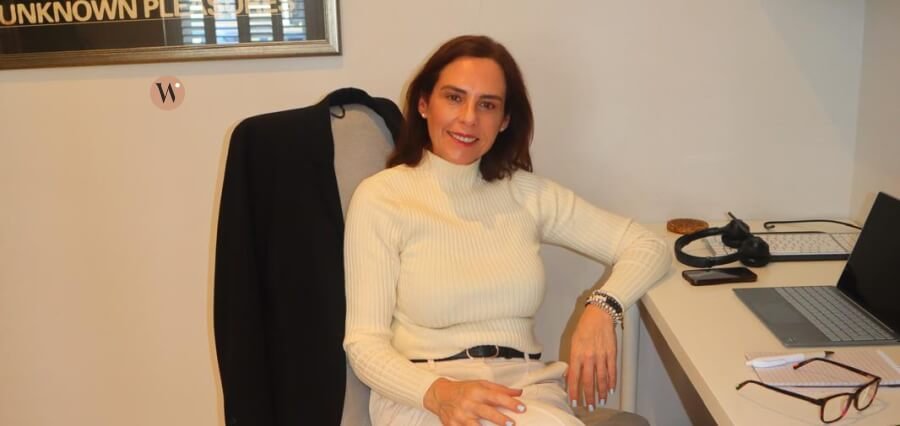
A single question has guided Carol Stafford across more than three decades of professional life: what does the person at the end of this data point truly need? It is a compelling question that has not only shaped a career path, but an entire philosophy of leadership. In her role as Client Executive for Medical Device and Diagnostics EMEA at Dassault Systèmes,Carol Stafford works at the intersection of technology and humanity every day. She partners with some of MedTech’s most ambitious companies to bring their innovations from European sketches into the hands of patients worldwide. She does all this grounded in the conviction that technology has no value unless it genuinely serves the individual at the end of the process.
Spanning more than thirty years across healthcare’s most demanding sectors, Carol Stafford brings both the strategic sharpness of a seasoned executive and the warmth of someone who has never forgotten why the work matters. In an industry where speed, data, and disruption dominate the conversation, she offers a calm, clear and deeply human perspective to MedTech.
A Career Built on Curiosity, Not Comfort
Most people gravitate toward a single discipline and stick with what they know.Carol Stafford chose an alternative course. Her background spans Virtual Twin Technology, Clinical Trial Software, Contract Research, Digital and Connected Health, Electronic Health Record and IT Integration, Nursing and Social Care, and Medical Device and Pharmaceutical Manufacturing. Her motivation was driven by a sincere interest in how each field connects to the others.
That curiosity has defined the kind of leader she has become. In her current position at Dassault Systèmes, she works with Medical Device and Diagnostics companies across EMEA, helping them bring their cutting-edge inventions to global markets. She does this by drawing on two powerful technologies: the Virtual Twin Experience, which enables companies to simulate device behaviour within the human body before a single physical part is manufactured, and the Medidata Clinical Trial Platform, which reimagines how clinical studies are designed, run, and analysed.
Carol Stafford describes herself as T-shaped professional: someone with wide cross-sector experience and deep specialisation where it counts. She sees this combination not merely as a personal advantage, but as a model that would greatly benefit the broader healthcare industry. The leaders best positioned to shape the future of MedTech, she says, are those who can move fluidly between science and strategy, between data and empathy, and between ideation and implementation.
Simulating the Future Before It Happens
In 2026, Carol Stafford speaks about End-to-End Digital Continuity with the assurance of someone watching an industry transform in real time. The old way of building medical devices, with siloed teams, manual handoffs, and fragmented information systems, is giving way to something far more interconnected, more intelligent, and considerably safer.
At the centre of this shift is Virtual Twin Technology. This is not science fiction. It is a working reality that Carol Stafford and her colleagues at Dassault Systèmes are bringing to companies across Europe every day. A Virtual Twin is a precise digital replica of a medical device, capable of being tested virtually across thousands of physiological conditions before a single physical prototype is produced. Carol Stafford puts it in practical terms: imagine being able to see exactly how a new heart valve behaves under stress, or how a neuro stimulator interacts with living tissue, before spending a cent on manufacturing. That is the power we are putting into our clients’ hands.
When the Virtual Twin Experience integrates with the Medidata Platform, a further possibility emerges: In-Silico Clinical Trials. Instead of waiting to discover how a device performs through expensive and time-consuming human trials, companies can now run thousands of digital simulations first. They arrive at the human trial stage with data, confidence, and clarity, not guesswork. Carol Stafford sees this as one of the most important shifts in medical device development. It is not about replacing human trials. It is about making them smarter, safer, and more targeted.
Never Losing Sight of the Patient
In the world of B2B enterprise software, it is easy to forget that behind every contract and every platform, there are human beings waiting for something to get better. Carol Stafford works deliberately against that tendency. Her position is direct: most people will, at some point in their lives, depend on a medical device or diagnostic. When that moment comes, we want to know it was built with absolute care.
This belief drives how she engages with clients on the Medidata Clinical Trial Platform. She considers, for instance, how easy it is for a trial participant to report their experience via their mobile phone. She advocates for Decentralised Clinical Trial capabilities that remove the burden of travelling to a clinic, enabling participation from home. Each design decision, in her view, is an opportunity to reduce unnecessary friction for the person on the other side of the screen.
She also champions Patient-Centric Design Reviews. These are structured sessions in which teams deliberately step into the participant’s experience. The benchmark is simple and uncompromising: if the system is too complex for a patient to use, it has failed. The most sophisticated backend is irrelevant if the person it is meant to serve cannot navigate it effectively. By embedding the patient’s voice into every stage of development, the resulting tools actually inspire people to use them.
Making Innovation Affordable
Carol Stafford operates fluently across science and finance. For MedTech startups facing long development timelines and capital pressure, her message is concrete: Virtual Twin Technology fundamentally changes the cost equation.
Under the traditional model, discovering a device failure during human trials is catastrophic, both clinically and financially. Shifting that discovery to a digital environment completely changes the risk profile, making virtual testing vastly cheaper than a physical failure. With the Dassault Systèmes Virtual Twin Experience, organisations can run a hundred digital iterations for the cost of a single physical prototype.
This makes R&D spending more predictable and shortens what she calls the startup valley of death. It is the critical gap between early-stage scientific promise and commercial reality. For investors and CFOs,Carol Stafford frames a startup’s most valuable asset in 2026 as its Digital Technical File: documented proof that a device has been tested against thousands of physiological variables before it ever enters a human trial. This is what turns a high-risk bet into a confident, well-evidenced investment.
The Lesson That Changed Everything
Early in her career, Carol Stafford was involved in launching a monitoring device that was technically sound. The engineering was solid and the science was validated. On deployment, frontline users rejected it. They did not see the innovation; they saw extra training, disrupted routines, and a technology that felt like a threat to their professional expertise. The resistance was immediate and intense.
That experience produced a principle she has held ever since: technology does not win on its technical and clinical merits alone. It succeeds when the people using it feel a tangible improvement in their lives. She stopped leading with functionality and started with friction, identifying precisely what was getting in people’s way and addressing it. Her message shifted: this technology is not here to replace your knowledge. It is a tool to free up your time for the high-value work only you can deliver.
The same approach governs her work today, whether the context is a diagnostic system or a Virtual Twin deployment. Real adoption does not automatically follow from people understanding a technology. It happens when they feel relief from using it. That is when resistance gives way to advocacy, and that is when transformation sticks.
Advice for Women Who Are Just Getting Started
WhenCarol Stafford alks to women who are building their careers in healthcare and technology, she is open and honest. Her message centres on what she calls Domain Fluidity – the ability to move across sectors, learn new disciplines, and resist the pressure to define oneself by a single area of expertise.
She gently challenges the assumption that specialisation is always the safest path. In a world where AI and automation are reshaping entire industries, she believes the individuals most likely to thrive are those who can translate across domains, connect solutions across sectors, and adapt without losing their footing. Generalists, she argues, carry toolkits that do not go out of date. Their breadth is their resilience.
She is equally candid about the mindset to sustain a long, joyful career. “When you stay authentically curious and comfortable being a beginner, you develop a learning quotient. This is the capacity to acquire new skills faster than those who have remained in a single lane. And practically speaking, following your curiosity keeps the work engaging and alive. It keeps burnout at bay. It means that even after thirty years, there is always room for growth and something new to discover.”
The Legacy She Is Working Toward
Carol’s professional goal is to help displace the trial-and error culture that has constrained MedTech innovation for too long. Other highly regulated industries, like aerospace and automotive, adopted predictive simulation decades ago. Medical device development, despite its high stakes, has remained attached to slow, expensive physical cycles: design, build, test, fail, and start again. Closing that gap is central to her work.
Through the Virtual Twin Experience, she is enabling companies to simulate thousands of iterations in the digital world, finding and fixing failures long before they reach a patient. The In-Silico evidence this generates not only satisfies regulatory scrutiny; it makes the entire development process more ethical, efficient, and human.
What makes Carol’s contribution truly compelling is that she consistently maintains the connection between technical complexity and human impact. The digital thread she describes – a single source of truth linking R&D, manufacturing, clinical, and commercial teams – is not only an architectural concept. It is a philosophy. It reflects a conviction that when every person in a system works from the same information, decisions improve, errors decrease, and the device that ultimately reaches a patient is the safest it can possibly be.
As MedTech races forward, Carol’s rare blend of strategic vision and grounded empathy ensures that rapid innovation is guided by human wisdom.