
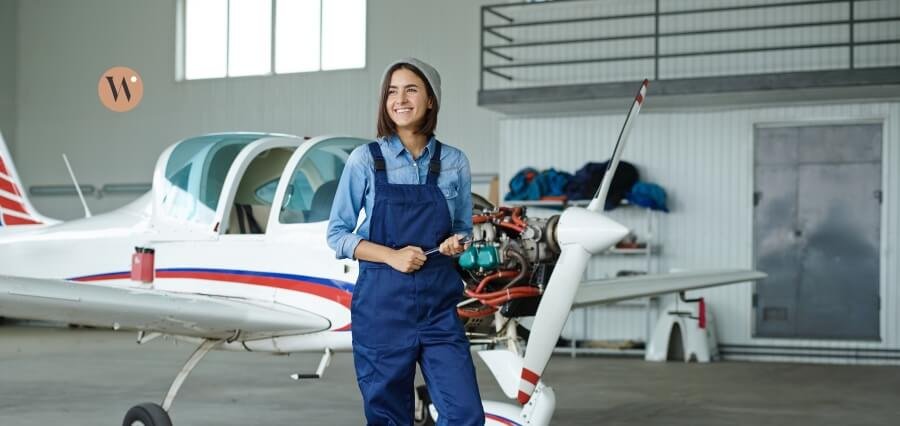
The aviation sector has been one of the key mediators of technological advancements and global interconnections. However, the management of this sector has been mostly male-dominated. The disparity has been questioned over time, it is now very clear to airlines, airports, manufacturers, and regulators that leadership diversity is not only a moral obligation but also a commercial necessity. Women leadership empowerment in aviation is being positioned as the most important factor for a viable, creative, and future-ready industry. Today, women are choosing careers in aviation as pilots, engineers, air traffic controllers, safety officials, and executive leaders. But, at the top of senior decision-making levels, their presence is still scarce. To close the gap, there needs to be a mixture of policy, change in attitude, and continuous involvement in talent development. The women inclusion in leadership roles in the aviation industry would be a perfect solution to bring new ideas and better management as the sector grapples with sustainability, digital transformation, and shortage of the workforce.
Breaking Barriers
The most fundamental problem for women to reach aviation leadership positions for a long time has been the existence of structural and cultural barriers. Such barriers are biased recruitment and promotion processes even if the bias is unconscious, fewer opportunities for high visibility assignments, and a lack of female role models in top positions. Women in operational roles such as pilots and maintenance engineers usually have to deal with the old and outdated perceptions of their capabilities and that they are not suitable, which in turn can cause their career progression to be slower even if they perform at the same level.
It takes a deliberate decision and action by the organisations to dismantle these barriers. Some of the very important first steps are transparent promotion criteria, bias-aware hiring practices, and leadership accountability. Companies that actively track and report gender diversity results are more likely to pinpoint their shortfalls and take corrective actions. Besides that, regulatory bodies and industry associations have a significant role in setting the bar, sharing the best practices, and recognising those organisations that demonstrate real progress. The fierce and lasting commitment by senior leadership to these initiatives is what ultimately brings change that lasts, stronger governance, and improvements throughout the aviation ecosystem.
Building Talent
Building a rich supply of female leaders should start very early, right from education and awareness about the career. To get girls and young women to think of a career in aviation, female outreach in schools and universities is necessary, along with the presence of women who have made it in the industry. Women-oriented scholarships, internships, and cadet programmes can ease the financial and confidence barriers which, most of the time, act as discouragers in technical and leadership tracks. Besides, early engagement in science, technology, engineering, and leadership will make the interest last and make the girls more qualified.
Also, within companies, mentorship and sponsorship can be very helpful to the career growth of the women. Mentors offer guidance and help develop skills, whereas sponsors on the other hand, they are very active advocates for women to be given the organization roles and assignments that challenge them. Leadership training programmes which deal both with the technical side and executive readiness are very effective if they are open to everyone and are in line with succession planning. By putting money into talent development, airlines can be sure that women are not only coming in but also climbing the ladder to positions where they have the power.
Enabling Culture
An enabling organisational culture remains the foundation for women leadership roles to be sustained over time. It is a society that is inclusive and supportive to the integration of work and life. In particular flexible scheduling, parental leave, and return to work programmes are what women employees’ value most. Aviation is a very demanding industry with the staff working irregular hours and carrying a heavy responsibility, and without supportive structures, a significant number of talented women may decide to discontinue the leadership track at their career stages which are critical for them. Continuous managerial support and fair performance evaluation frameworks also have great influence on the retention of employees.
As a matter of fact, it is equally significant to develop circumstances that valuing diverse leadership styles will be the outcome. Women leaders generally tend to be collaborative, empathetic, and inclusive, and such approaches make teams perform better and have a positive effect on safety culture. When these characteristics are acknowledged as leadership qualities rather than exceptions, organizations have improved decision-making and employee engagement as a result. Establishing channels free from fear for giving feedback and dealing with harassment or discrimination, in general, gives more trust and inclusion.
Conclusion
Empowering women to be leaders in the aviation industry is not only a moral imperative but also a strategic move that contributes to the sector’s long-term sustainability. Despite the numerous challenges that the aviation industry is facing, such as labor shortages, environmental commitments, and rapid technological changes, the industry can still choose to be led by an inclusive leadership. Women bring to the table essential views, abilities, and leadership styles that elevate safety, innovation, and organizational resilience and for that reason, their advancement is indispensable for the industry’s evolution. Indeed, the transformation to real change is going to be a tremendous undertaking and it will require all stakeholders to be involved in the process: companies, regulators, educators, and industry bodies. By dismantling systemic barriers, funding talent development, and building cultures that foster inclusion and offer flexibility, aviation industry has the potential to create a leadership pipeline that reflects diversity at all levels. Continued collaboration, open accountability, and measurable results will, therefore, be the factors that will help the transition from promises to a lasting change. The next generation of women leaders in the aviation industry will be instrumental in driving performance while ensuring the sector remains relevant, responsible, and well prepared to navigate an increasingly dynamic global environment.